
2016-17 Innovative Teaching Showcase
Ideas
IDEA #5: Facilitating Critical Discussion
“Becoming aware of our assumptions is a puzzling and contradictory task. Very few of us can get very far doing this on our own.”2
Learning Intention
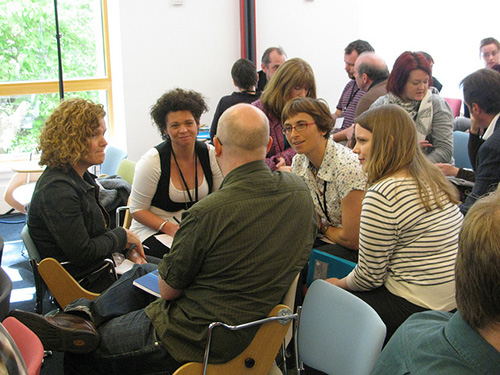
Brookfield identifies critical thinking development as a social learning process that requires the help of others to free us from the prisons of our own perceptual frameworks. Discussion with peers is a powerful way to engage students in the process of reflecting and articulating ideas. “Students discover assumptions and new perspectives most meaningfully when a peer brings it to their attention.”2
Overview
Students often report finding it easier to acknowledge new ideas or questions coming from peers than from teachers. Because their examples and questions are likely to be more relevant to their own experiences, and because the power dynamic is less intimidating, students may be more tolerant of the uncomfortable process of critical thinking when it is a process they are discussing ideas with their peers.2
Instructions
1. Establish a classroom climate that is conducive to challenging conversations. Build community, provide clear guidelines, and model respect and humility. Also see Idea #1: Safe Spaces for Difficult Dialogue
2. Have students generate questions to be discussed. In small groups, let students brainstorm key questions about the material 1, perhaps using prompts like “what I’m most wondering about the reading is…” or “the idea I most disagree with is…”2 You could also ask students to come to class with two quotes from the reading, one they wish to affirm and one they wish to challenge, to be used as discussion starters.2
3. Ask open-ended questions as a “way of inviting people to wonder” about the topic.2How and why questions can help students explore ideas and frameworks, while who, what, and if questions probe values and priorities. Some ideas:
- Why are we doing it this way?
- What might it look like if…?
- What are we trying to achieve?
- Who are we?
- What do we want to be remembered for?
- What do we stand for?
- What have we always wanted for this community?
- How could we make that happen?
4. Allow time-outs for students to process complex ideas or cool off from heated exchanges. Let them free-write or draw pictures or concepts maps to express their thoughts about the discussion.
Considerations
- What do I need to be aware of?
- What other resources might be helpful?
1. Bean, J.C. (2011). Helping Students Read Difficult Texts. Engaging Ideas: The Professor’s Guide to Integrating Writing, Critical Thinking, and Active Learning in the Classroom . San Francisco, CA: Jossey-Bass.
2. Brookfield, S.D. (2012). Teaching for critical thinking: Tools and techniques to help students question their assumptions. San Francisco, CA: Jossey-Bass.