
2016-17 Innovative Teaching Showcase
Ideas
IDEA #3: Deep Reading
“We have to do more than take our students out to sea. We have to teach them to fish in the deep.”1
Learning Intention
“A deep approach to reading is an approach where the reader uses higher-order cognitive skills such as the ability to analyses [and] synthesize...in order to negotiate meanings with the author and to construct new meaning from the text.”4 Many students have difficulty reading deeply and may need help to develop their reading skills.
Overview
While we may hope that our students are developed enough in their reading skill to be able to learn new ideas, analyze and understand multiple viewpoints, or even synthesize and reconstruct understanding, many students are still developing those skills and need support. There are things faculty can do, and activities they can ask students to do, to support their emerging skills in critical reading.3
Instructor Activities
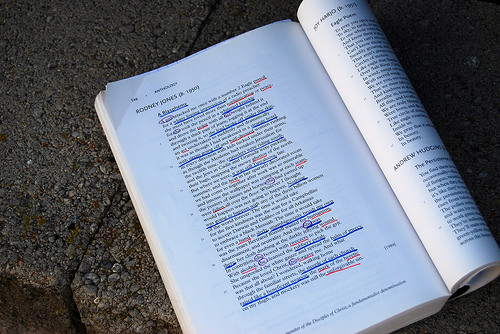
Model the process: Show students examples of your own annotations on a text to demonstrate how to read deeply and take effective notes.1
Stimulate interest: Use non-graded pretests or exploratory case studies/projects to help students identify questions and gaps in knowledge or to plant seeds of curiosity about the text.1
Provide context: Most texts rely on some amount of cultural literacy (background knowledge, allusions, key vocabulary) that will present obstacles for students who aren’t familiar with those details. Prep students for passages by sharing useful background information that will help them understand or interpret the text.1
Student Activities
Use “What It Says” and “What It Does” statements: Summarize each paragraph with a short paraphrase of what the selection says (a topic sentence) and what it does (the purpose or function it aims to serve).1
Identify rhetorical intent and effect: Consider these trigger questions about a particular article or text:1
- Before I read this text, the author assumed that I believed…
- After I finished reading this text, the author wanted me to believe ...
- The author was/was not successful in changing my view. How so? Why or why not?
Engage with the author: Look at written text as the author’s side of a conversation with you; add your voice by drafting questions or responses to the author’s ideas.3
Identify key ideas/connections: Create concept maps or flowcharts (or even a rap or song) that identifies key ideas and their connections to other ideas in the text or the rest of the course.2
References
- 1. Bean, J.C. (2011). Helping Students Read Difficult Texts. Engaging Ideas: The Professor’s Guide to Integrating Writing, Critical Thinking, and Active Learning in the Classroom. San Francisco, CA: Jossey-Bass.
- 2. Weimer, M. (2009, Sept 1). Reading Assignment Strategies that Encourage Deep Learning. Faculty Focus. Available online at https://www.facultyfocus.com/articles/effective-teaching-strategies/reading-assignment-strategies-that-encourage-deep-learning/
- 3. Odegaard Writing and Research Center (n.d.) Close Reading. Available online at https://depts.washington.edu/owrc/Handouts/Close%20Reading.pdf
- 4. Reis, R. (n.d.) Strategies to Promote a Deep Approach to Reading. Tomorrow’s Teaching and Learning, Message #928. Stanford University: Tomorrow’s Professor Postings. Available online at https://tomprof.stanford.edu/posting/928