Fostering Agency in Learning
Portfolio
Christine L. Johnston, Ph.D.
Department of History
Cultivating Agency, Engagement, and Significant Learning in History Education
Encouraging Meaningful Engagement
In my teaching, I aim to help students foster an appreciation for diverse human experiences, prepare for thoughtful participation in their communities, and develop research and analytical skills, including critical thinking and written communication. Most students who come through my courses are not pursuing future careers in the study of antiquity, but all can benefit from the opportunity to think deeply about the human experience and spend time critically assessing written and material evidence. Given the varying backgrounds, education goals, and learning needs of the student body, I design courses using universal design that support multiple modes of learning, empowering students to exercise agency over their experience and engage meaningfully with the material. Three core ways I approach this in my courses is through the use of active and authentic learning activities, promoting student agency over learning with choice and “Bundled Assignment” frameworks, and incorporating renewable assignments using Wiki Education.
"Given the varying backgrounds, education goals, and learning needs of the student body, I design courses using universal design that support multiple modes of learning, empowering students to exercise agency over their experience and engage meaningfully with the material."
To encourage meaningful engagement, I aim to cultivate competencies that fall into both traditional cognitive dimensions (e.g., knowledge acquisition),1 as well as affective competences (e.g., the development of communication and leadership skills).2 By combining cognitive and affective goals with an emphasis on values-based emphasis critical competencies (such as complex problem solving, respect for others, principled ethical behaviour, interest in lifelong learning, and interpersonal skills),3 students are situated for what is known as “significant learning” (or “deep learning”). The Significant Learning paradigm (Fig. 1), developed by L.D. Fink, incorporates learning objectives that “include but also go beyond content mastery,”4 which serves to position students for continued growth:
If students learn to apply content, can see how it connects with other knowledge, understand the human implications of what they have learned, and come to care about the subject and about learning how to keep on learning, it seems much likelier that they will both retain what they have learned and continue to enlarge their knowledge after the course is over.5
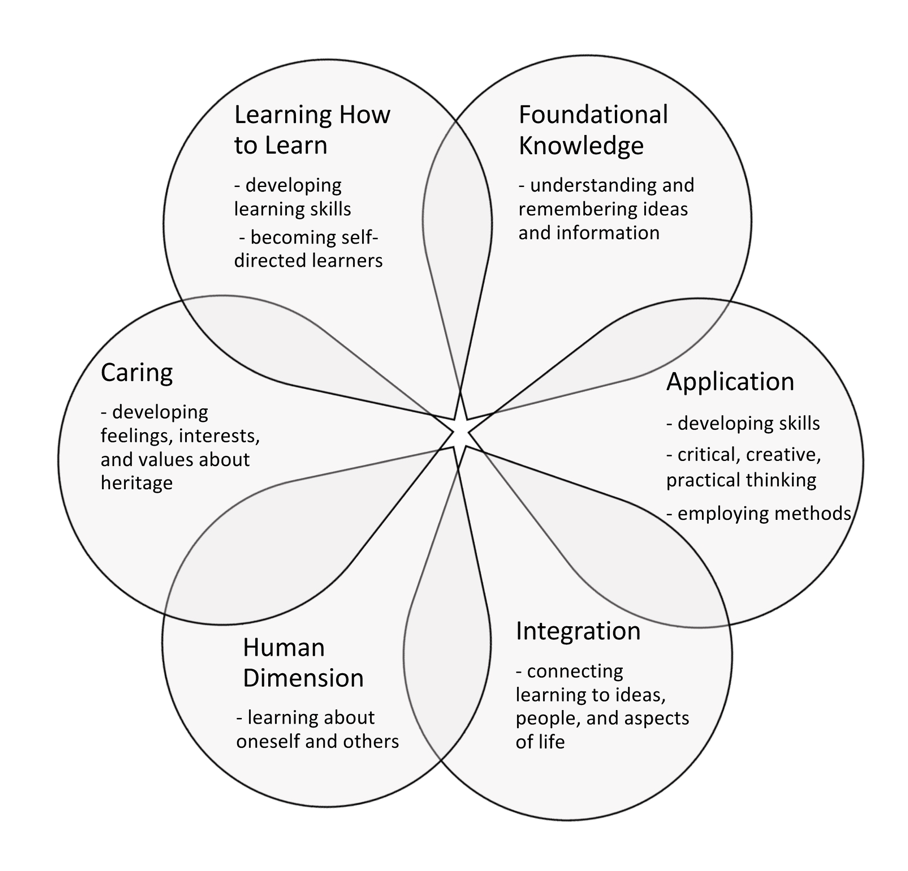
Figure 1. Fink’s Taxonomy of Significant Learning (adapted from Fink 2003a, 30).
Figure 1 Description
The six concepts of the Fink’s Taxonomy of Significant Learning are displayed in a flower diagram with the following sections and descriptors:
- Learning How to Learn
- developing learning skills
- becoming self-directed learners
- Foundational Knowledge
- understanding and remembering ideas and information
- Application
- developing skills
- critical, creative, practical thinking
- employing methods
- Integration
- connecting learning to ideas, people, and aspects of life
- Human Dimension
- learning about oneself and others
- Caring
- developing feelings, interests, and values about heritage
Authentic Active Learning
Within the classroom, these learning objectives are pursued using a learner-centered approach that incorporates a variety of classroom and assessment activities, many employing active and authentic learning methods. My approach follows a constructivist paradigm that values learning attained through mentally (and in some cases physically) engaging work that allows students to think and problem solve. The goal of this type of learning, often referred to as active or experiential learning, is to transcend the lower cognitive objectives of remembering declarative knowledge and focus on procedural learning centering on the higher cognitive levels (you can read more about Active Learning in the CII’s Teaching Handbook: Active Learning Toolkit). Experiential learning activities can be considered “authentic” when students participate in work that aligns with the types of activities undertaken by professionals in that field.6 These types of activities allow learners to develop what is known as a “disciplinary mind,”7 and aims to induct them into “communities of practice.”8
"My approach follows a constructivist paradigm that values learning attained through mentally (and in some cases physically) engaging work that allows students to think and problem solve."
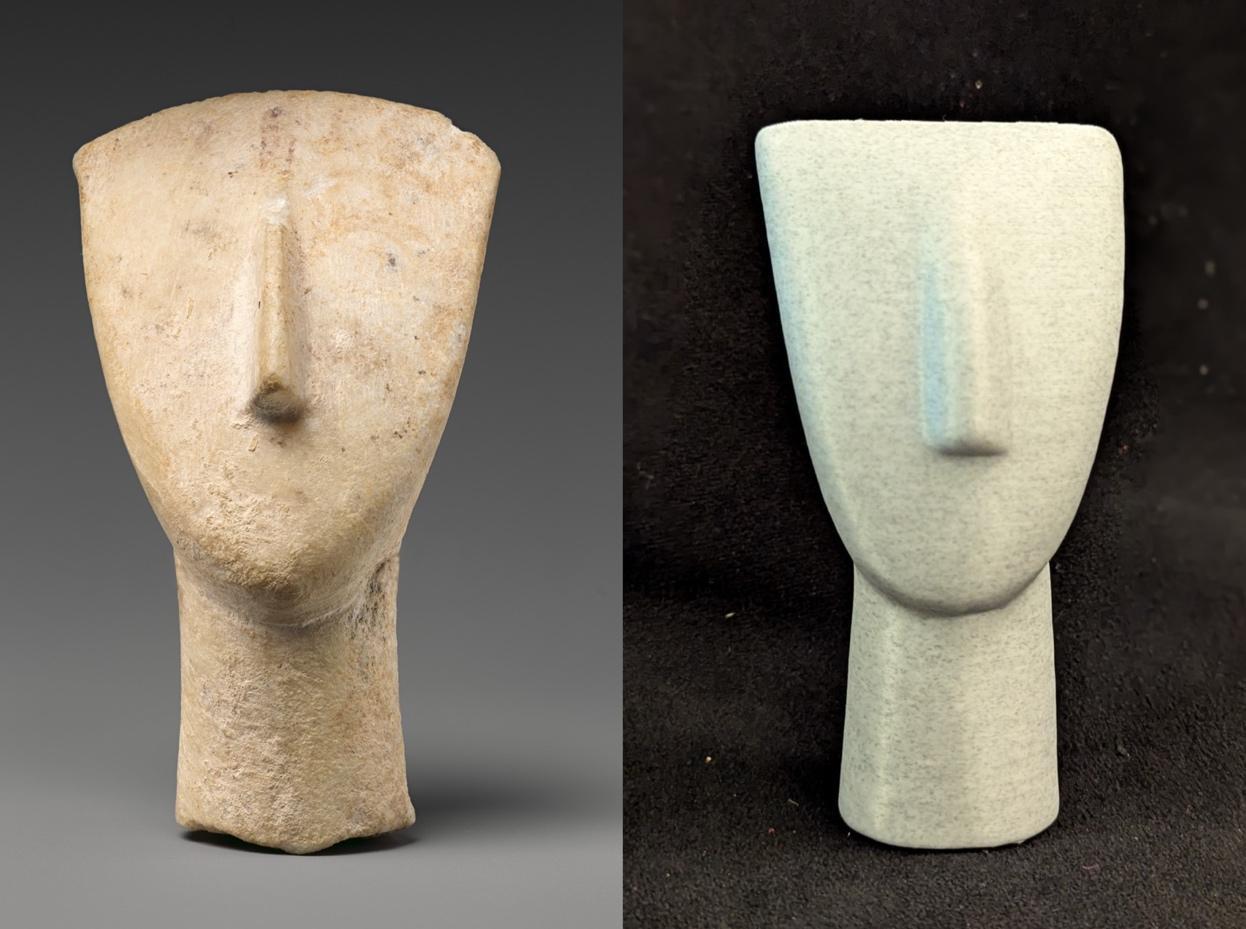
Figure 2. Athenian Tetradrachm and 3D Print (Cleveland Museum of Art, inv. 1941.296; print from model by Pinotoon).
Figure 2 Description
Incorporating the first three letters of the city name—ΑΘΕ—with then-iconic images of the patron goddess Athena and her owl, the Athenian tetradrachm was among the most widely traded and most recognizable coins of the ancient world. The olive leaves on Athena’s helmet and the small crescent moon behind the owl date this coin after the Persian Wars.
In my GUR survey “Introduction to ‘Western Civilization’ to 476 CE” (HIST 111), students assess 3D printed reproductions of material objects in three different teaching modules:
- the decipherment and interpretation of ancient scripts and texts;
- the study of Greco-Roman coins (see Fig. 2); and
- cultural heritage, museum holdings, and restitution (see Fig. 3; for a full discussion of the Coin Module, see Johnston et al. 2023; for the cultural heritage module, see Johnston et al. 2025).
These modules developed out of a collaborative research project with three former MA students in the History department, assessing the pedagogical opportunities afforded by 3D technologies to foster significant student learning and enhanced course accessibility. Physical reproductions of objects are incorporated into these modules to facilitate the study of the ancient cultures and histories through direct observation and active learning, while shifting away from grandiose markers of “civilization” to the study of every-day objects of living individuals. The use of digital reproductions also grounds important conversations about cultural heritage, especially around topics like cultural heritage protection, looting and trade of illicit antiquities, and avenues of restitution. Within these learning activities, students work in groups, which has demonstrated benefits elevating the deep learning experiences of students—I try to integrate group work and peer learning opportunities into all course levels, through activities like student presentations, structured class debates, formal peer review, in addition to the activities involving 3D-printed object reconstructions.
"...students work in groups, which has demonstrated benefits elevating the deep learning experiences of students—I try to integrate group work and peer learning opportunities into all course levels, through activities like student presentations, structured class debates, formal peer review, in addition to the activities involving 3D-printed object reconstructions."
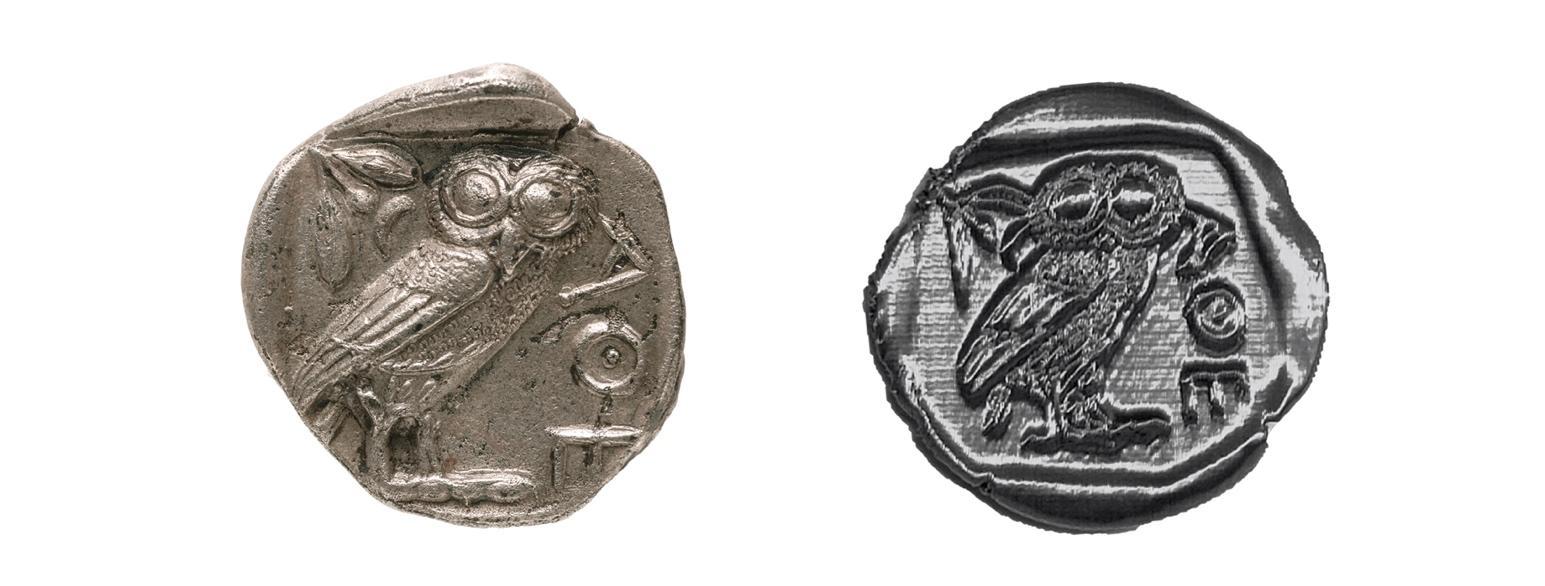
Figure 3. Cycladic marble head, ca. 2700–2500 BCE (Metropolitan Museum inv. 69.11.5), and 3D reproduction printed from the 3D model by DaniSaez
Student Choice and Assignment “Bundling”
As courses on the ancient world frequently draw students from different disciplines, I encourage students to pursue interdisciplinary research that appeals to their individual interests and skillsets by setting open-topic research projects. In the past, student projects have included digital media such as game code, creative writing pieces, visual art, musical and dance performance, and ethnographic projects. Individual engagement is also encouraged through regular reflection assignments on course content. These reflections are structured around broad prompts that encourage learners to connect course materials and class discussion to their own learning and lived experience, effectively scaffolding learning onto individual knowledge networks. Additional large group “mental mapping” activities are also incorporated into class time, allowing students to collaborate in the scaffolding process.
With assignments and assessment, I offer a variety of activities and assignment types to meet different learning objectives and to ensure that students are given many avenues to succeed. For example, most courses include traditional critical reading assignments, creative activities, metacognitive reflections, and other skill-building work (e.g., the “Research Worksheet” included in introductory GUR classes like HIST 111). Creative assignments take many forms, such as creative writing pieces, the design of museum collections that address holes in our historical sources, and critiques of the presentations of the past in film. In some classes (e.g., Ancient Empires, Digital Methods, Public History), courses include digital assignments that task students with conveying their research questions, hypotheses, and conclusions in interactive Timelines or StoryMaps.
With assignments and assessment, I offer a variety of activities and assignment types to meet different learning objectives and to ensure that students are given many avenues to succeed. For example, most courses include traditional critical reading assignments, creative activities, metacognitive reflections, and other skill-building work (e.g., the “Research Worksheet” included in introductory GUR classes like HIST 111)."
Assessment is designed to accommodate flexible student needs. Automatic grace periods of one week are offered for all assignments, providing students with the flexibility to successfully complete coursework while navigating their own individual scheduling needs. Additionally, as each course includes in-class participation in the assessment, students are provided the opportunity to meet the participation requirement through emailed communication instead of in-class discussion should the latter present a barrier to their success. Student agency over the learning process is also encouraged by providing extra assignment opportunities to demonstrate improvement and allowing resubmission of certain assignments. Though this requires a substantial investment of labour, I have seen great success in student engagement, writing proficiency, and course performance. This is also an aspect of my teaching that students regularly comment on in course evaluations.
Assessment is designed to accommodate flexible student needs."
Student agency over the learning process is also encouraged by providing extra assignment opportunities to demonstrate improvement and allowing resubmission of certain assignments."
To support learner success and agency, I have worked to develop assessment structures that provide multiple avenues to success while allowing flexibility and choice. This is achieved in two ways. The first is the use of Bundle Grading, which I first introduced in my Fall 2020 classes. Although Bundle Grading is commonly associated with Specification Grading approaches, I generally only apply specification grading methods to short metacognitive reflections (e.g., the Course Expectation and Reflection posts in HIST 111). Students are given the option to select from different grading bundles that weigh different assignment types more heavily. Each bundle requires that students submit multiple assignments of each type (e.g., Critical Reading Reflections and Creative Assignments), however the relative weighting varies between each bundle. Although they can select one assignment type to focus, the bulk of the bundle work is split across assignment groups (examples are included for both introduction and upper-level courses). This provides some flexibility in individual coursework, while still requiring that learners complete multiple assignments of each type. Student bundle selection tends to be fairly evenly distributed across the different bundle types.
"To support learner success and agency, I have worked to develop assessment structures that provide multiple avenues to success while allowing flexibility and choice. ... Students are given the option to select from different grading bundles that weigh different assignment types more heavily."
In all classes, including those with Bundled Grading, students are also provided with agency through assignment selection throughout the quarter. For example, there are generally between four and six critical reading assignments assigned through a quarter, with the expectation that students will complete between three and five (depending on the class and bundle choice). This provides students with flexibility in scheduling their workload through the quarter, while also allowing them to select the assignment topics that most closely align with their learning interests. This structure also provides students with the opportunity to improve through the quarter. While students may only need four or five Reading Reflection scores for their final grade, they are given the option to complete more assignments than needed and to drop their lowest score(s). In every course to date there has been a significant number of students (generally 10–20%) who have exercised this option and taken the opportunity to improve both their critical reading and writing skills and to raise their grades in the class. While this adds additional grading labour, the result is an on-average improvement of 1–2 letter grades for students who take the opportunity to complete additional assignments and drop grades.
"While this adds additional grading labour, the result is an on-average improvement of 1–2 letter grades for students who take the opportunity to complete additional assignments and drop grades."
Renewable Assignments and WikiEducation
Starting in Fall 2020, I have begun assigning research projects in conjunction with the Wiki Education program. Initially, the project was designed to facilitate pandemic learning when the Western Library was closed, however the digital and information literacy benefits, as well as the renewable assignment value, has encouraged me to keep it in my upper-division courses. I have now included this project in seven courses and have refined the structure to incorporate Wiki article contribution along with a more traditional research paper proposal. This allows students to produce traditional historical studies based on the research conducted through the quarter, while also developing digital literacy skills, participating in peer review, discussing the ethics of knowledge production and dissemination, and providing the opportunity for students to participate in public history.
"[This Wiki research project] allows students to produce traditional historical studies based on the research conducted through the quarter, while also developing digital literacy skills, participating in peer review, discussing the ethics of knowledge production and dissemination, and providing the opportunity for students to participate in public history."
The student response to this experience has been very positive. Student reflections have particularly noted the challenge of writing in a neutral tone and without argument. Most encouragingly, some students have explicitly admitted that this challenged them to avoid “cherry-picking” sources to support the argument they were making, forcing them to provide neutral assessments of sometimes opposing perspectives in historical discourse. Many students have also noted the benefit of the peer review experience, as well as the project’s impact on their understanding of digital content and its means of production. The research paper proposal has also proved successful—it not only provides a more traditional history writing experience, but the prospectus format challenges students to distill their arguments while clearly integrating supporting evidence. This structure also allows them to focus more closely on the structure and flow of their work. The most common student complaint about the project has related to the learning curve related to the platform, which I have worked to ameliorate by preparing taped walk-throughs demonstrating the editing process.
Not only has this project proved successful in enhancing digital and historical literacy among my students, but the public history contribution of this project is substantial. Across the seven courses in which I have included Wikipedia projects between Fall 2020 and Spring 2025, students have edited 233 articles, adding 1,265,587 bytes in content (representing a 34.36% increase in overall size of the edited articles). As of February 1, 2026, these edited articles have combined views of almost 56 million since their last student edit, representing an immense contribution to public history. Since students (in most cases) select topics from a curated list I provide, they are able to exert agency in choosing topics of interest to themselves, while I am able to broadly target our class contributions in support of broader Wikipedia initiatives, such as addressed gender gaps in Wiki content, as well as countering inaccurate and harmful narratives relating to ancient cultures and histories. As noted by students in their project reflections and course evaluations, the Wiki project gives them the opportunity to “feel like we were making a difference.” As another student notes, “the Wikipedia project is more valuable to humanity at large than a standard research essay, while still building the same skillset.”
"Not only has this project proved successful in enhancing digital and historical literacy among my students, but the public history contribution of this project is substantial."
Footnotes
- Cognitive goals are characterized as “fact-oriented” or “memory” learning, which represents a traditional approach to learning that has been critiqued as being “of limited value to either (the students) or society.” (Gardiner 1994, 5). ↩
- Fink 2003, 29. ↩
- Gardiner 1994, iii. ↩
- Fink 2003, 33. ↩
- Fink 2003, 57. ↩
- Stein et al. 2006, 239–41. ↩
- Stein et al. 2006, 240. ↩
- Communities of Practice are defined as “groups of people who share a concern or a passion for something they do and learn how to do it better as they interact regularly” (Wenger-Trayner and Wenger-Trayner 2015; first developed by Lave and Wenger 1991). ↩
Works Cited
- Fink, L. Dee. Creating Significant Learning Experiences: An Integrated Approach to Designing College Courses. San Francisco: Jossey-Bass, 2003.
- Gardiner, Lion F. Redesigning for Higher Education: Producing Dramatic Gains in Student Learning. ASHE-ERIC Higher Education Report 7. Washington: George Washington University, 1994.
- Johnston, C. L., Alan Wheeler, Alexis Nunn, Erin Escobar. “Visualizing and Materializing Objects: 3D Printed Coins Assignment.” In B. Fischer and H. Jacobs, eds., Visualizing Objects, Places, and Spaces: A Digital Project Handbook, 2022. https://doi.org/10.21428/51bee781.6e766336.
- ———. “Teaching Ancient History with Digital Reproductions: Integrating 3D Printed Objects for Authentic Active Learning.” In Ancient Pasts for Modern Audiences: Public Scholarship and the Mediterranean World, edited by Chelsea A.M. Gardner and Sabrina Higgins, 166–200. London: Routledge.
- Stein, S.T., G. Isaacs, and T. Andrews, “Incorporating Authentic Learning Experiences within a University Course,” Studies in Higher Education 29, no.2 (2006): 239–58.
- Wenger-Trayner, Etienne, and Beverly Wenger-Trayner. A Brief Introduction to Communities of Practice. 2015. Accessed June 6. 2023.