2015-16 Innovative Teaching Showcase
Portfolio
Science Education Team
Science, Math and Technology Education
A Learning Cycle approach to Guided Inquiry in a Four-Course Interdisciplinary Science Series
Introduction
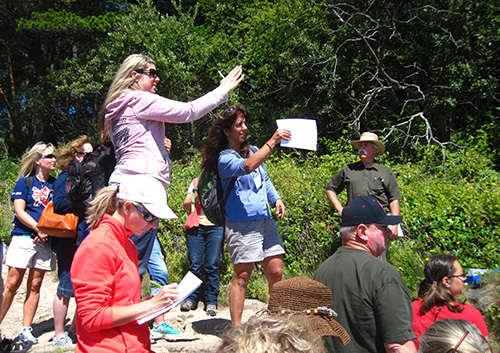
Description and Goals
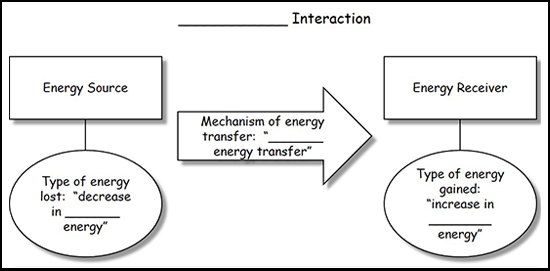
- help students (future teachers) develop conceptual understanding of certain "big ideas" in science, especially as they relate to transfers and transformations of matter and energy,
- model the evidence-based, student-centered teaching and learning practices we would like our students to implement in their own classrooms,
- help students understand the nature of science[2] and use scientific practices[3], and
- help students gain understanding of common K-8 student difficulties with the same science content they are learning.
We have documented learning gains in SCED 202-204 and published some of these findings in science education literature (Borda, Anzalone, Lockett, & Wuotila, 2014; Donovan et al., 2013, DeBari et al., 2008).
Curriculum Philosophy and Structure
The 201-204 curricula are based on the idea of constructivism (Piaget, 1978;
Vygotsky, 1978), which claims students actively build
knowledge based on prior ideas and assumptions. The National Research Council's
report, How People Learn (Bransford, Brown, & Cocking, 2000)
emphasizes the importance of constructivism and describes three "Key Findings"
of learning from cognitive science and education research:
- Students' incoming knowledge influences learning and must be engaged to promote deep understanding;
- Students must not only develop factual knowledge but organize it in a way that makes it easy to retrieve and apply; and
- The act of reflecting upon and monitoring one's learning, called
metacognition , is crucial to developing deep understanding
A student's incoming ideas take on enormous importance because incomplete or incorrect ideas provide a shaky foundation for future learning. There are several commonly held misconceptions and student difficulties in science (some of which are highlighted in the Private Universe Video Series) that hinder learning. The SCED 201-204 curricula have been designed to help students confront many of these ideas head-on. They all use a guided inquiry approach to help students construct "big ideas" in science through constructivist-based methods based on the key findings above. Each curriculum uses a learning cycle approach for each unit that incorporates the following features:
- Students acknowledge their incoming ideas by responding to prompts designed to surface common ideas and misconceptions;
- Students collect and interpret data from experiments. These data and the questions designed to help students interpret the data are designed in a way that results in them constructing a "big idea" in science;
- Students reflect back on their original understanding and notice how it has changed. At the end of each major unit, students again reflect on their changing understanding through a learning commentary assignment in which students compare their initial and final ideas with respect to a "big idea" and discuss the classroom experiences triggered changes to their thinking.
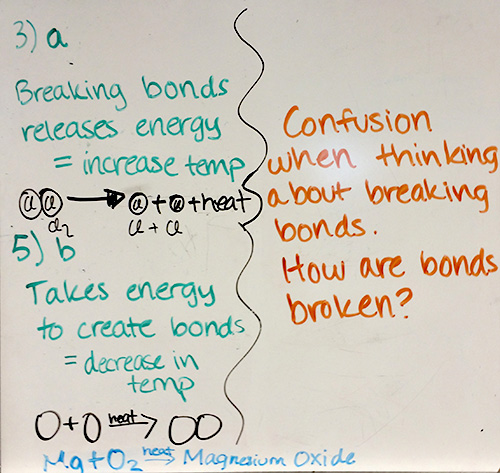
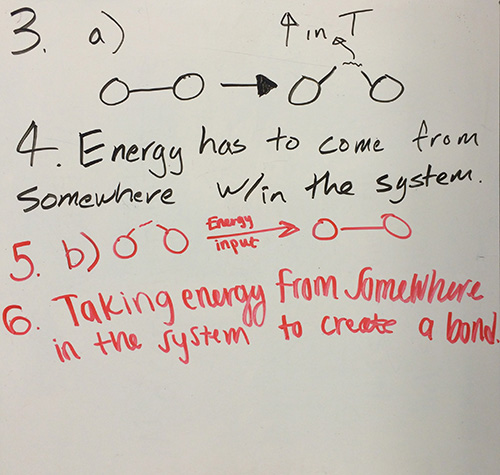
An example of this learning cycle in the chemistry curriculum (SCED 204) is an activity that relates bond breaking or formation to energy changes. Students are first asked how they think the temperature would change if bonds are breaking or forming. Then, they measure temperature changes as a liquid evaporates (intermolecular bond breaking) or as water is added to cupric sulfate (chemical bond formation). The results are opposite what most students predict. Students record their data and are guided to make sense out of it, so that they ultimately build a sophisticated model describing the energy transfers and transformations involved in bond breaking and formation. Finally they compare their mental models to their initial ideas and discuss how their thinking has changed. The students have a similar experience in the Earth science curriculum (SCED 202) when they investigate evidence of Earth events and are surprised to discover that living things developed and evolved mostly in the last 12% of Earth history. In the life science curriculum (SCED 203), students discover that plants undergo cellular respiration and therefore take in O2 and produce CO2 just as animals do. These are only a few examples of the multiple learning cycles found in each curriculum.
Classroom Culture, Student Collaboration, and the Role of the Instructor
The guided inquiry pedagogy used in the SCED 20X classes requires that students are comfortable sharing ideas with their classmates, even though
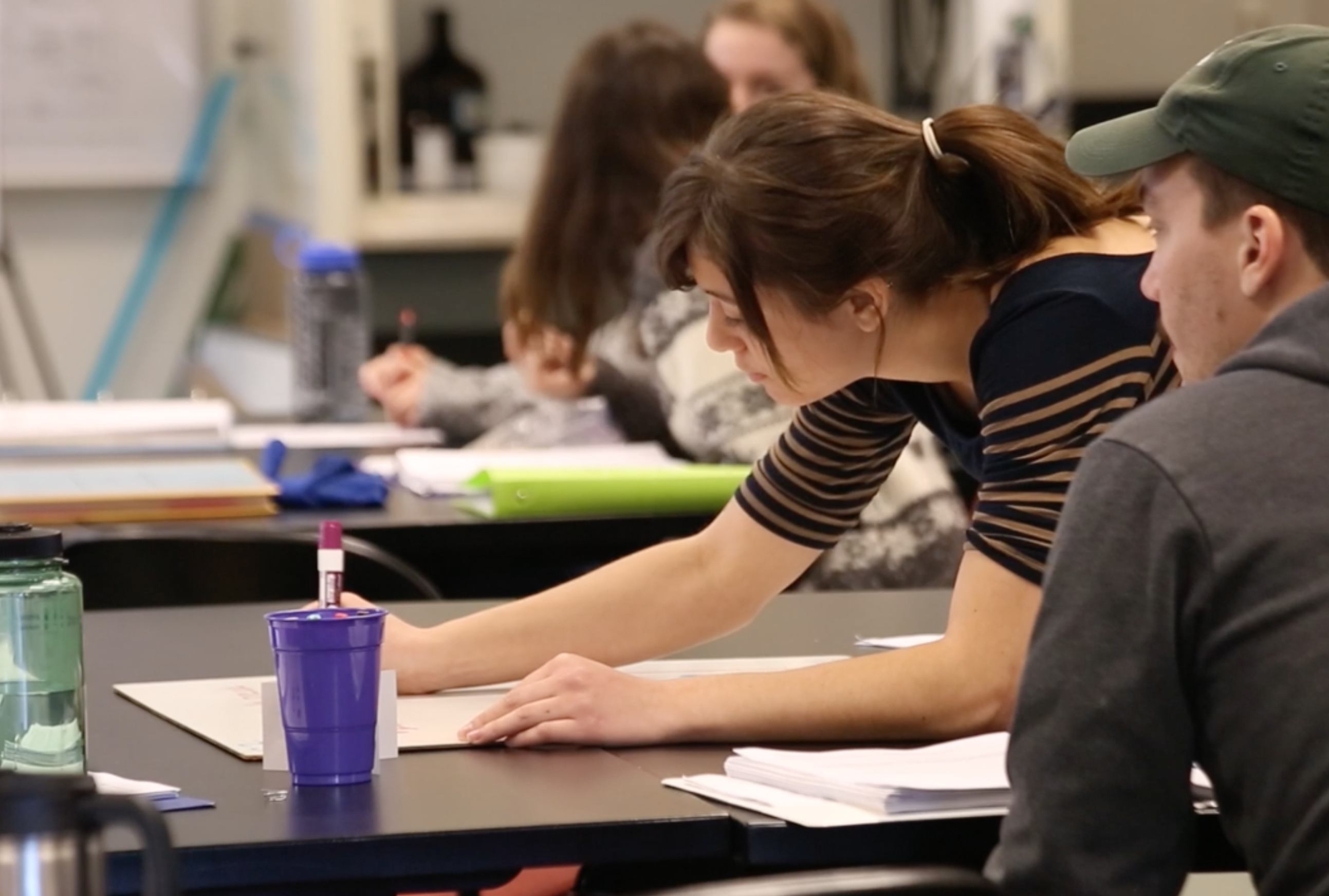
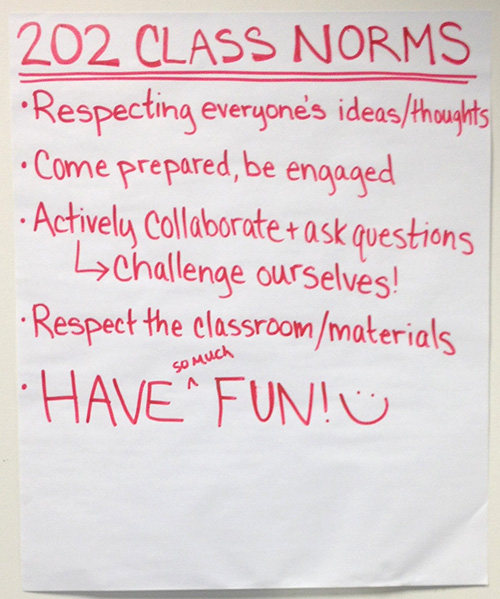
their ideas may not be correct (yet!). Thus, an important aspect of our classes is establishing and maintaining a positive classroom culture. One way we do this is by establishing class norms. On the first day of class, students share with each other the "rules" that they think everyone should adhere to during the quarter and we come to an agreement about our class norms. The norms are recorded on a sheet of paper and displayed on a wall, where they can be referred to throughout the quarter. By collectively establishing class norms, students have control over the classroom culture.
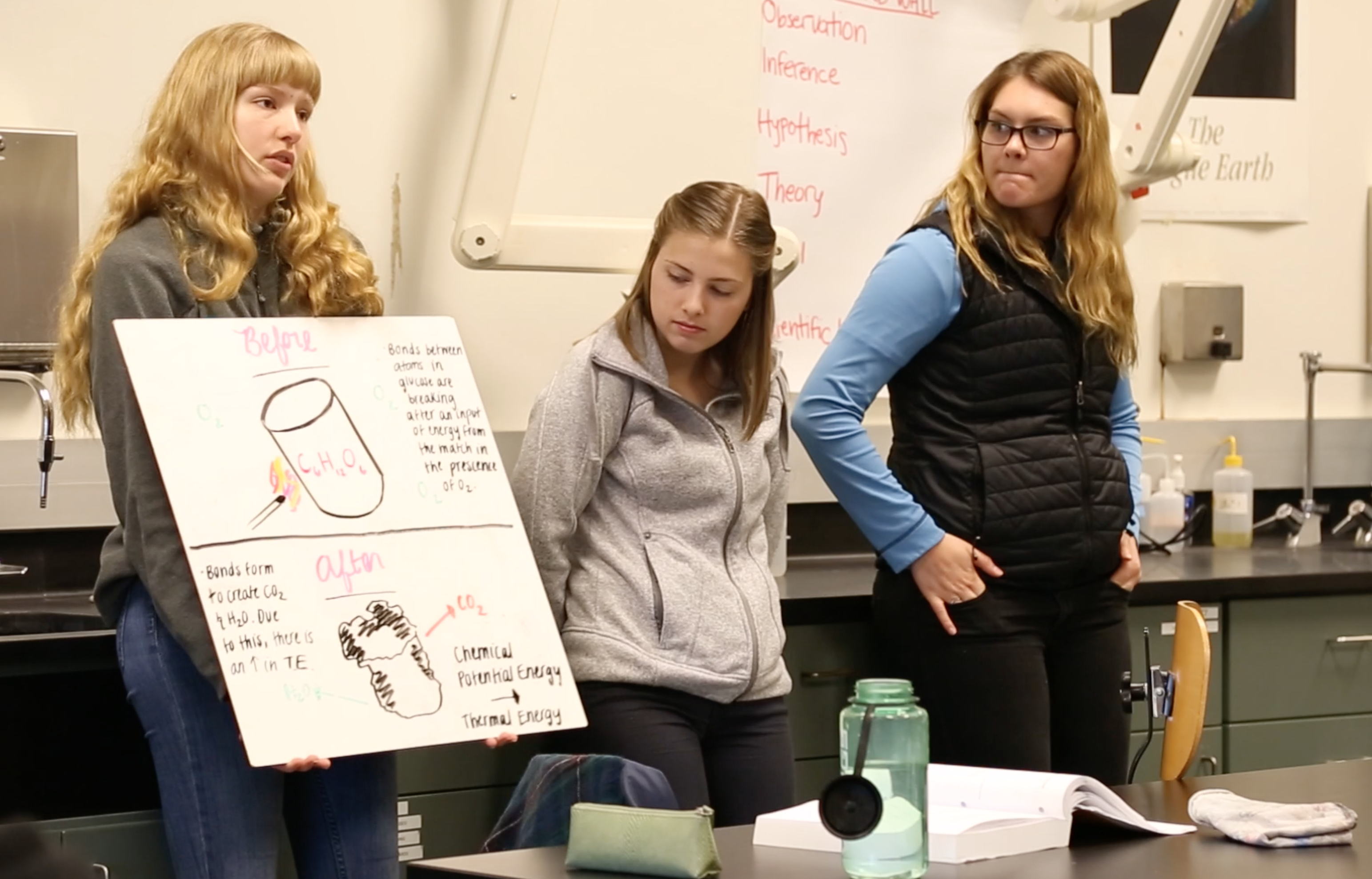
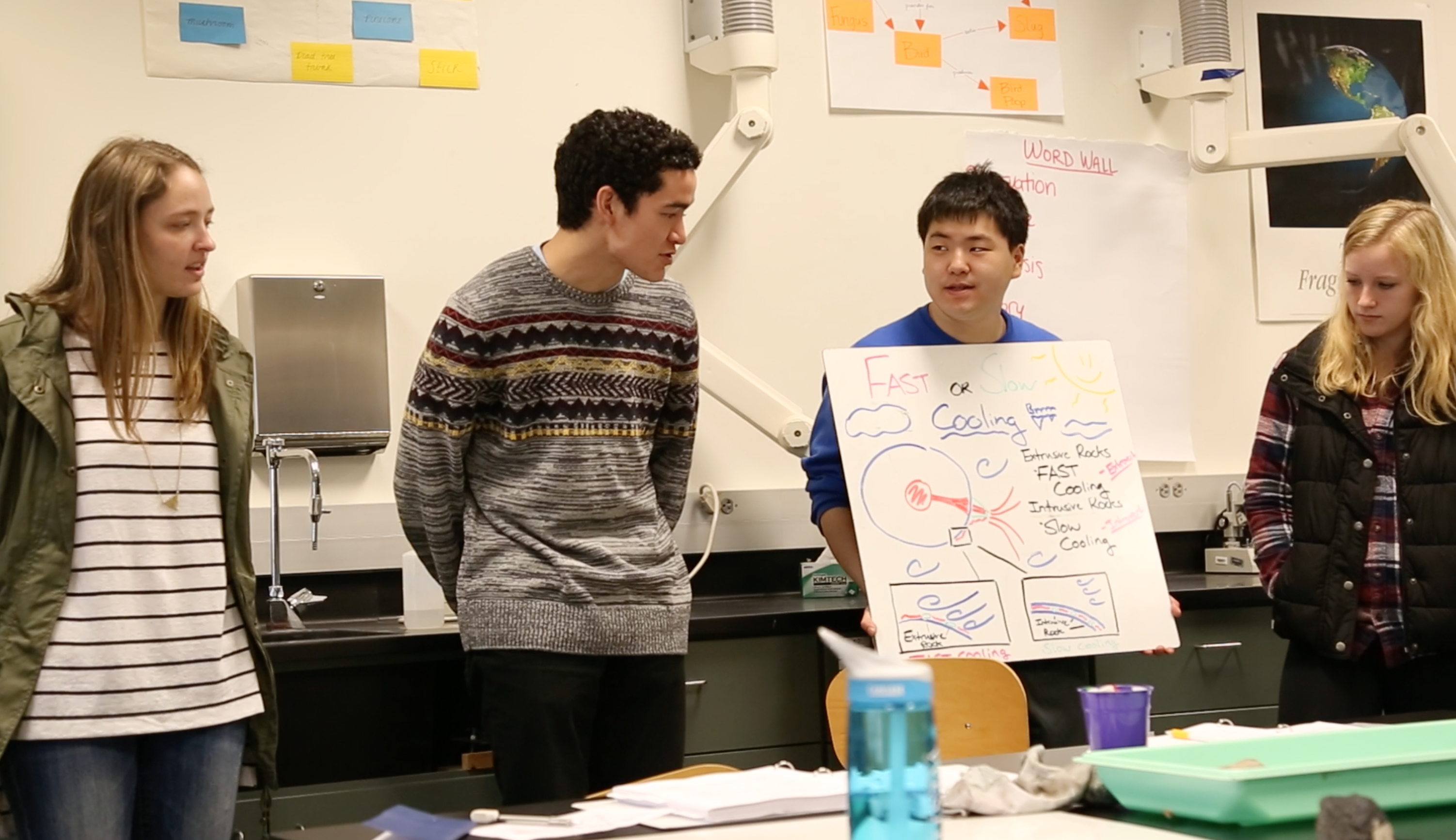
The pedagogy also depends on student collaboration. The students work in established groups to develop initial ideas about a phenomenon, generate evidence via investigations, develop and support conclusions from the evidence (sense-making), compare/contrast their initial ideas with the evidence gathered, and reflect upon their learning. Each group also shares its ideas with the rest of the class, both during discussions about initial ideas at the beginning of an activity and about summarizing questions at the end. During initial ideas discussions, groups share their ideas about a phenomenon, and students and faculty ask questions to clarify those ideas. The goal of these discussions is to make students' initial ideas transparent to everyone in the class. These discussions are facilitated using whiteboards. Each group records their collective ideas on a whiteboard, usually using a combination of text and illustrations. When it is their turn to share, students stand up, show their whiteboard to the class, and use it explain their ideas to the class. Class discussions about summarizing questions also use whiteboards, but the purpose of these discussions is much different from an initial ideas discussion. Now students are asked to support their claims with evidence and compare their newly developed understanding with their initial ideas. This is the point in the learning cycle in which students need to come to a correct understanding about the phenomenon they are investigating.
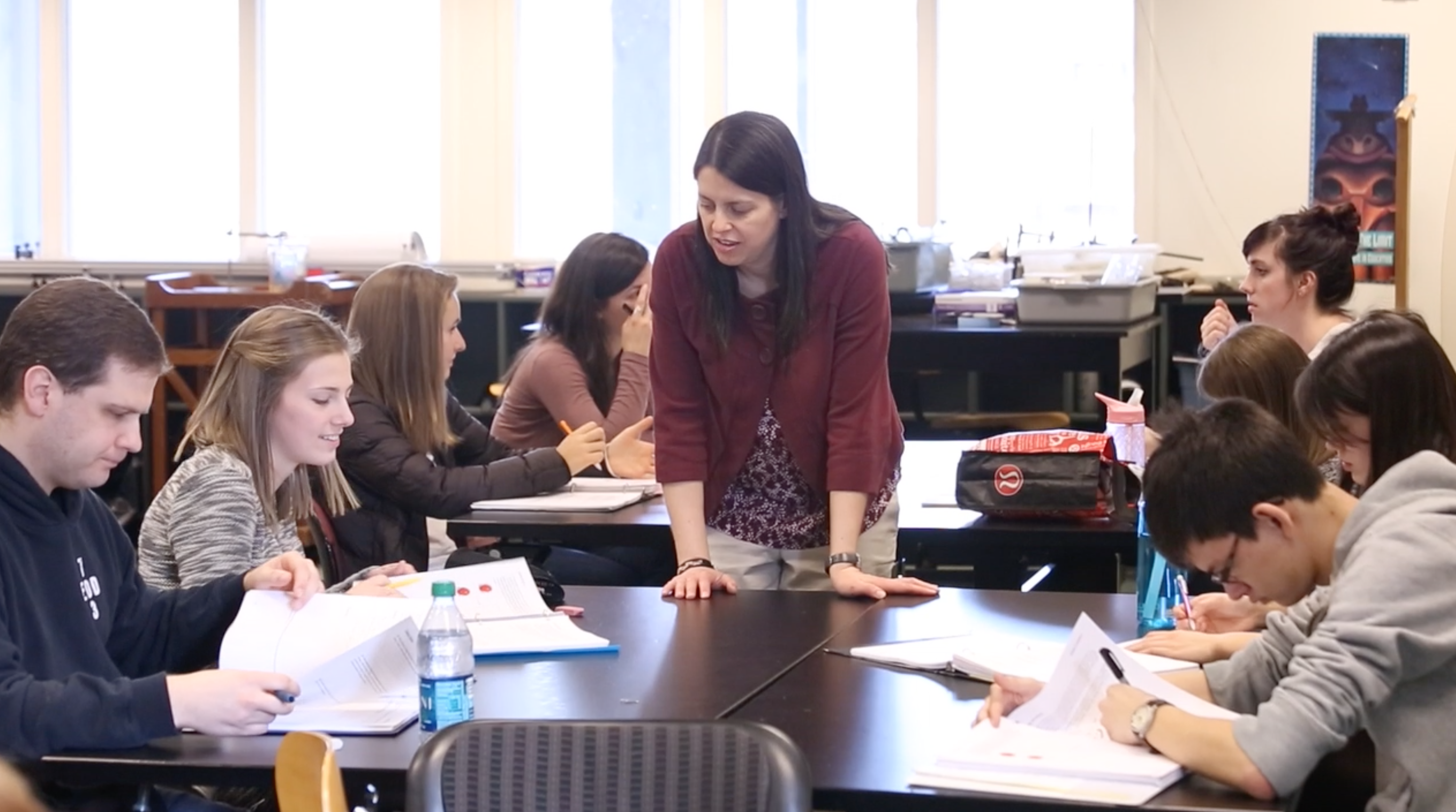
The role of the instructor is very different in our courses compared to more traditional courses. There is no lecturing. In fact, the instructor is rarely even at the front of the class. Instead, we circulate between groups, eliciting preconceptions, probing students' emerging understanding through questioning and maintaining a collaborative atmosphere. Instructors also facilitate the class discussions by comparing groups' ideas, contrasting emerging ideas with the class' initial ideas, and encouraging students to reflect on how their thinking has changed.
Evidence of Effectiveness
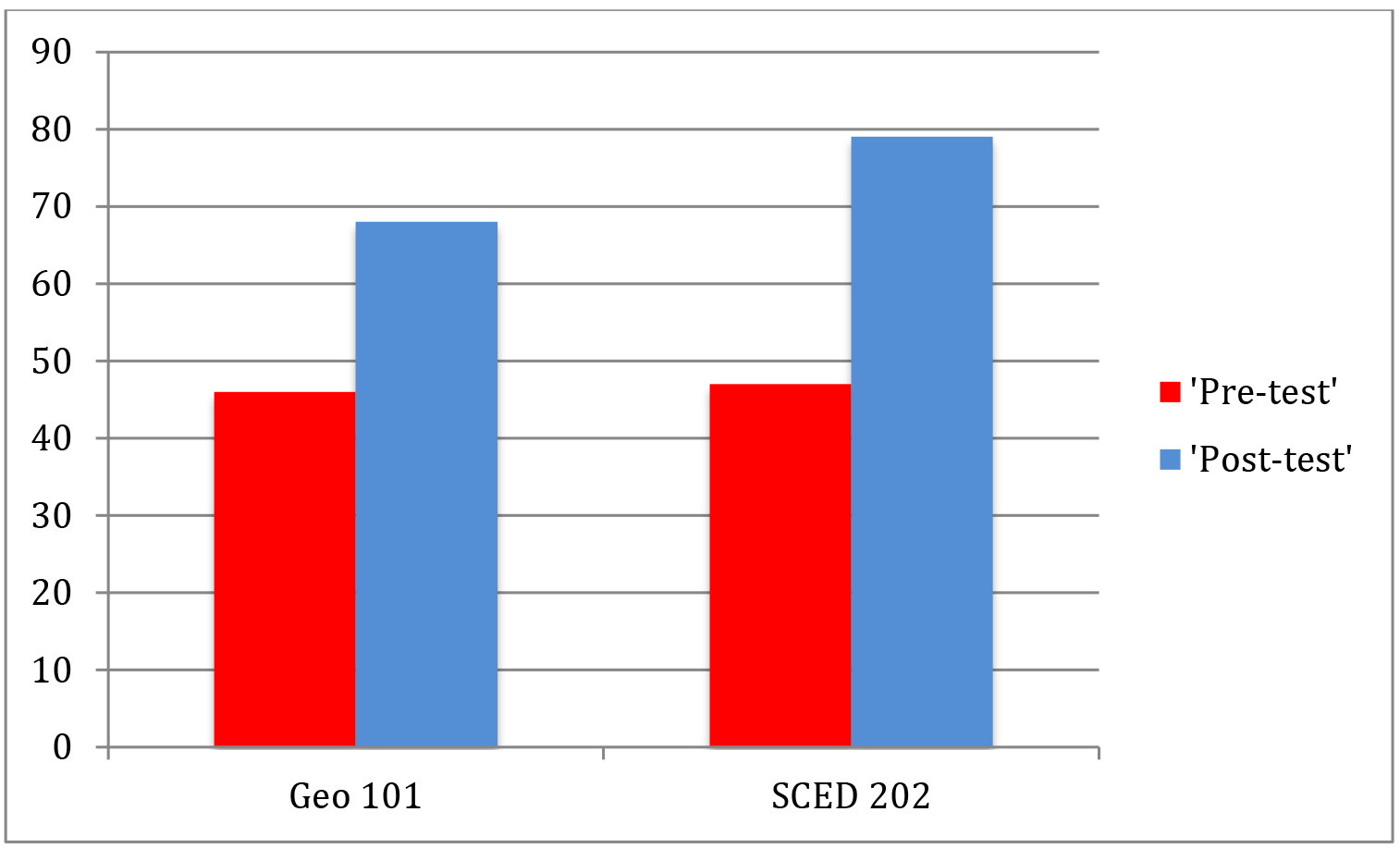
The geology curriculum (Geology and Everyday Thinking, GET) is also being used
at Whatcom Community College, Skagit Valley College, and Everett Community
College in Washington,
and at Cal Poly San Luis Obispo in
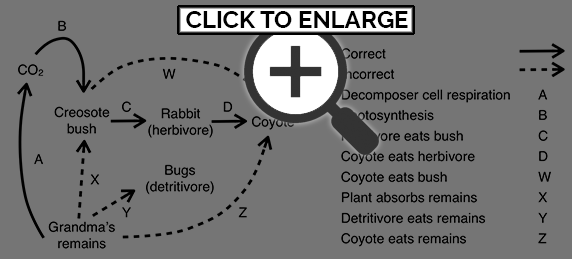
Grandma Johnson had very sentimental feelings
toward Johnson Canyon, Utah, where she and her late husband had
honeymooned long ago.
Because of these feelings, when she died she requested to be buried
under a creosote bush in the canyon. Describe below the path of a carbon
atom from Grandma Johnson's remains,
to inside the leg muscle of a coyote. NOTE: The coyote does not dig up
and consume any part of Grandma Johnson's remains.
The biology curriculum has recently been published as Life Science and Everyday
Thinking (LSET) by It's About Time
publishing company, a publisher specializing in science
curricula
developed with NSF funding. In a recently published paper, we compared how
students in classes using LSET compared to students in traditional lecture
courses on the "Grandma Johnson"
question (Ebert-May et al., 2003). This is a validated assessment of student
understanding about the transfer of matter in an ecosystem. The question is:
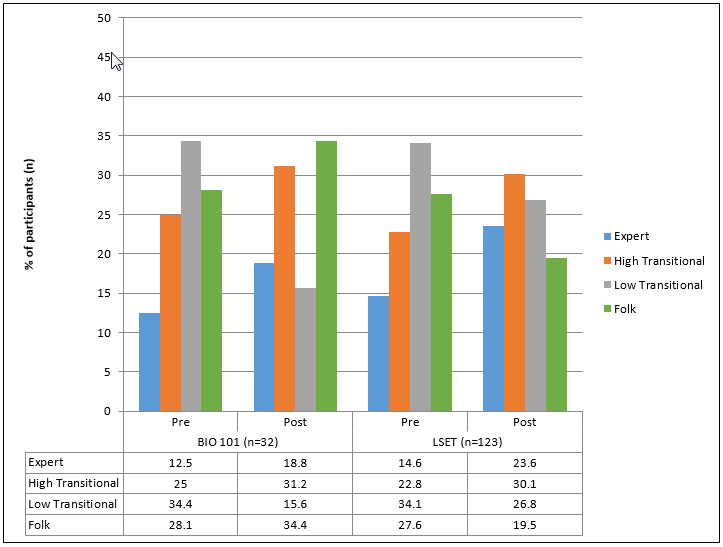
We also found that students in classes using LSET had a more sophisticated view
about the nature of science at the end of the class compared to students in a
more traditional
biology course (Bio 101). We used the Views About Science Survey (VASS), which
measures students attitudes about learning science and the nature of science.
Students in the
LSET course had a significantly greater shift towards a more "expert" view of
learning science at the end of the course. This study was done by two
colleagues, Dr. Irene Salter
and Dr. Leslie Atkins, at the California State University, Chico.
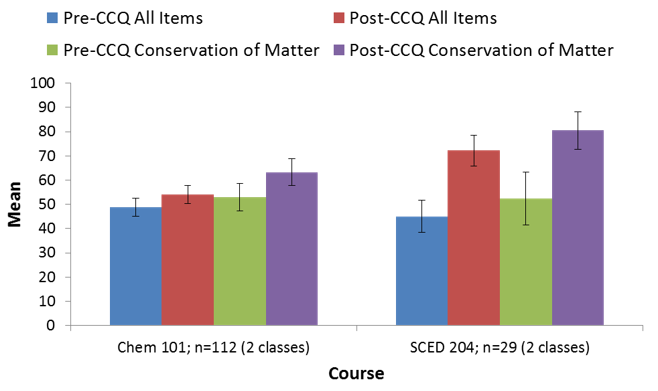
We've also been tracking student learning data for SCED 204, and comparing this
to Chem 101, which has similar content but was taught in a more traditional
lecture style
(since these data were collected, Chem 101 has been adapted to use more
inquiry-based pedagogies). When two of each of the courses were compared (all
four were taught by the same instructor),
SCED 204 students showed significantly larger gains on a Conceptual Chemistry
Questionnaire (CCQ) than Chem 101 students, even on content that had roughly the
same time-on-task between courses
(conservation of matter).
We have used the SCED 201-204 instructional model for teacher and faculty
professional development, as well as in our own courses in Geology, Chemistry
and Biology.
In workshops for "Change at the Core", which seeks to improve instruction in
introductory STEM courses at WWU, as well as in the new faculty 3-day workshop
on teaching
and learning, faculty engage in similar inquiry-based learning experiences.
These set the stage for learning about current education research and planning
strategies for
their upcoming classes. Further, community college faculty were part of the
development team and regularly teach SCED 20X equivalents at Whatcom Community
College and Skagit
Valley College. Finally, many of us have begun to apply some of the guided
inquiry activities and strategies we developed for the 20X series to our larger
introductory science courses.
Additional Contributors
Please see the Profiles section to see how Jim Stewart, Pinky Nelson, and Steve Gammon contributed to inquiry-based learning in science education at Western Washington University.
References and Resources
Constructivism in context: Factors affecting
student learning in four different classrooms. In D. W. Sunal, C. S. Sunal,
e. L. Wright, C. L. Mason &
D. Zollman (Eds.),
Using 'How People Learn' as a blueprint for
developing teaching strategies in an introductory geology course,
Advantages and Challenges of Using Physics
Curricula as a Model for Reforming an Undergraduate Biology Course.
[1] Ebert-May, D.